
FarmDyn: testing energy and technology choices at farm level
How would higher diesel and fertiliser prices affect production? Should a farm invest in energy and mineral
fertiliser saving through new machinery and technology? Can a technology like precision fertilisation
increase nutrient use efficiency and lower emissions without threatening farm income?
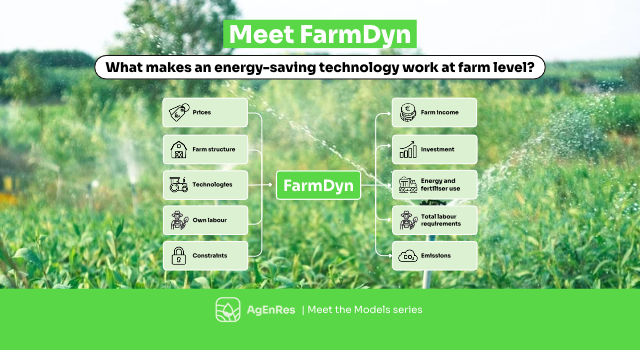
These are some of the questions that European farms come across, and that cannot be answered without considering each individual farmer and farm. Questions and answers related to economic and environmental impacts of farm level technology choices will be different for each farm depending on characteristics like farming system, size, intensity (cropping plan, number of livestock per ha) and availability of own (or family) labour and capital.
This is the third episode of our “MeeTheModels” series, where we explore the models that conform the AgEnRes modelling toolbox. At this point, you should already be familiar with the words “complexity”, “heterogeneity” and “interconnection”, and how soft linkage between models can lead to more precise foresights. In our first entry, we met OPEN-PROM, which sets the energy context in the modelling toolbox. Then, GLOBIOM, which turns the energy context (e.g. energy prices) and detailed evidence from farms (mitigation potentials and cost and revenues from technologies, structural change...), into sector-wide scenarios. Today, we meet FarmDyn, which gives us the farm-level perspective.
Image 1: Tractor Speading Liquid Fertiliser by hiv360
What is FarmDyn?
FarmDyn is a technology-rich bio-economic model that simulates production and investment decisions at the level of an individual farm. It examines how those decisions may change in response to external shocks, including changes in output prices, input prices, and the availability of new technologies or machinery.
The model takes the role of a fully informed, rational decisionmaker who wants to maximise farm profit while respecting physical, environmental, and legal constraints. It uses a mixed-integer programming (MIP) approach, a mathematical optimisation technique which allows it to represent decisions that involve a mix of continuous variables (that can have any value. Like for example application of mineral N fertilisers per ha, nutrients from different feeds per head, etc.) and discrete variables (which must be countable whole numbers like investments in tractors, combines, plough, etc.), reflecting the reality on the farm.
Currently, FarmDyn can cover different branches of agriculture, including:
- arable farming;
- dairy farming;
- beef production; and
- pig production.
FarmDyn combines the economic and physical characteristics of a farm: Its crop component can represent different crop choices, grassland intensity levels, nitrogen and phosphorus use, and alternative tillage systems across several plots. Its livestock component represents herd size, feed rations, housing and other production requirements.
The model also accounts for labour (own and hired). Every activity or operation is linked to different machines, including tractors, and requires a defined amount of working time per hectare or animal. This makes it possible to investigate whether a technology saves labour, adds new management requirements or shifts work between farm operations and activities.
Machinery is also represented through characteristics such as:
- purchase price;
- useful life;
- maintenance costs; and
- diesel consumption per operating hour.
Complementing the list above, this makes it possible to investigate whether a technology saves diesel use. Savings in mineral N fertiliser input are possible from changes in mineral N fertiliser level per ha per crop and crop choices and investments in new technologies elike precision fertilization. This level of detail allows FarmDyn to connect technology choices with farm profitability, input use, investment requirements and environmental performance.
Image 2: Agricultural farmfield with grain storage by wirestock
What goes into FarmDyn?
FarmDyn begins with the characteristics of an individual or typical farm. Inputs can include:
-
hectares of arable land and grassland;
- number and type of animals;
- initial cropping plan;
- crop and livestock yields;
- available family labour;
- plot size and mechanisation level;
- machinery characteristics;
- purchased input prices;
- agricultural output prices;
- fertiliser requirements;
- feed composition;
- labour needs by operation; and
- regional or national cost assumptions.
Input and output prices can vary between countries or NUTS 2 regions, while remaining consistent among the farms represented within the same model setting.
What comes out?
FarmDyn produces a detailed picture of how the farm could respond to a scenario. Economic outputs include revenue, subsidies, purchased input costs, machinery costs, depreciation, and farm profit. The model can also report:
-
cropping choices by plot, intensity and technology;
- herd size and composition;
- feed rations;
- mineral fertiliser and manure allocation;
- machinery, stable and building investments;
- land purchases and the shadow price of land;
- labour requirements;
- energy balances
- emissions, including methane, nitrous oxide, ammonia, nitrogen oxides and CO₂ equivalents;
- nutrient surpluses; and
- organic matter balance.
This means FarmDyn does not simply indicate whether a technology is adopted. It can help explain what changes elsewhere in the farm when that adoption occurs.
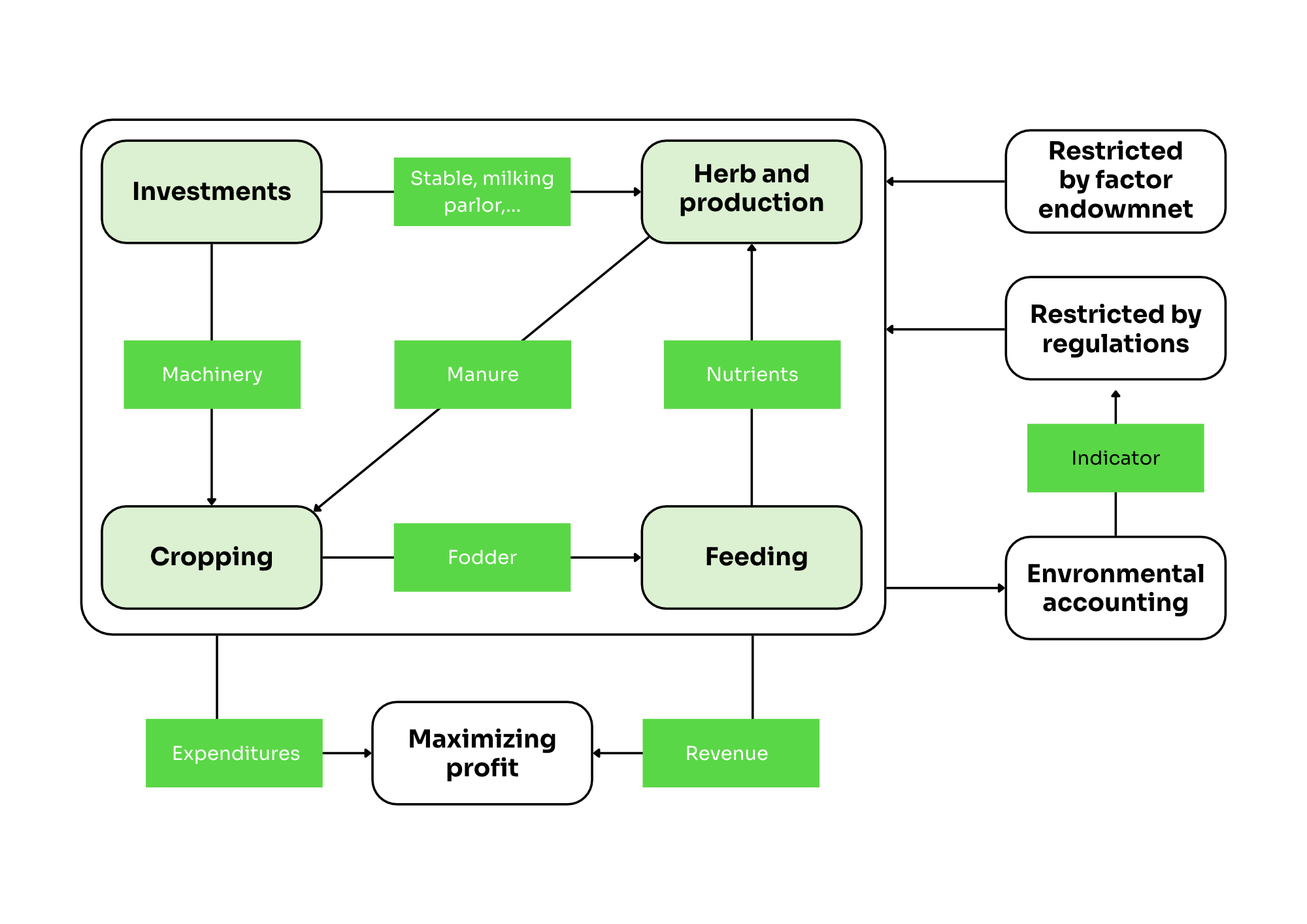
Image 3: FarmDyn graphical representation
FarmDyn in the AgEnRes toolbox
One practical AgEnRes use case involves implementing variable-rate precision fertilisation in cereals and rapeseed: The estimates supplied for this application place soil mapping, soil testing and equipment costs between approximately €24,000 and €83,000 per farm, depending on farm size. Estimated reductions in mineral nitrogen fertiliser vary by crop, from roughly 15% for wheat and rapeseed to 25% for barley.
The technology also creates trade-offs. More targeted driving and less overlap reduce diesel consumption from fertilisation by an estimated 7.5% per hectare and crop. However, data processing, software administration and machinery configuration add work, resulting in a net labour increase of approximately one hour per hectare under the assumptions provided. Estimated yield effects range from an increase of around 3% for wheat to around 4% for rapeseed.
This is exactly the kind of question FarmDyn is designed to investigate. A technology may reduce fertiliser and diesel use, but its value also depends on capital costs, labour requirements, yields and the characteristics of the farm. FarmDyn provides detailed evidence on the farm-level effects of technologies and scenarios. Its results can include changes in:
- investment costs;
- mineral fertiliser and energy use;
- labour;
- machinery requirements;
- crop yields;
- farm income; and
- emissions.
These results can inform larger-scale models in the AgEnRes toolbox. For example, GLOBIOM can translate FarmDyn’s relative technology costs and physical effects into add-on technology parameters or sector-level scenario assumptions. This allows AgEnRes to examine whether a technology that appears useful at farm level could also reduce fossil-energy exposure at a broader European scale.
Simply put, FarmDyn evaluates the farm-level choice, while GLOBIOM examines what wider uptake could mean at sector scale.
Image 4: Russian wheatfield by Great_Bru
FarmDyn gives the AgEnRes toolbox a level of technical and economic detail that larger-scale models cannot reproduce for every individual farm. It can help answer questions like:
- What farm characteristics determine whether a farm adopts a technology?
- How do energy and fertiliser price shocks change the optimal production plan?
- Which trade-offs appear between profit, energy use, labour and emissions?
- How does the same technology perform across different farm types and regions?
- How to improve macro assumptions regarding mitigation potentials and costs of technologies with micro data?
It also helps prevent a common modelling problem: assuming that a technically promising measure will automatically be economically attractive or widely adopted. Preventing unexpected outcomes of policies only focusing on technology scenarios.
Furthermore, the FarmDyn input also points to a possible structural implication: innovations that reduce energy and mineral fertiliser use may reinforce existing trends towards larger farms and plots. That proposition will need to be examined alongside regional modelling evidence. It provides a useful link to AgriPoliS, which explicitly represents interactions between farms, land competition and structural change.
In conclusion, FarmDyn asks what makes sense for one farm. The wider AgEnRes toolbox asks what happens when many farms face similar choices.